
Meet a Tree: Basswood

by John Zasada

Editor’s note: Author John Zasada is a retired US Forest Service research scientist. His interests and passions (and talents!) turned to special forest products upon his retirement. John is enamored with a common Minnesota tree species: basswood, also known as “American linden.”

 I have been fooling around with basswood inner bark in recent months. The photos accompanying this article are of a couple of “hot pads” made using both dyed and not-dyed inner bark of the basswood tree.

 Minnesota’s basswood trees provide an interesting opportunity to learn about the many uses of trees in the northern part of the state. The use of the inner bark is one way and it is not a well-known use. Many of you are likely familiar with the use of the basswood for carving. Among all of the trees in this region (northern Minnesota), basswood ranks at the top of the list for many carvers.

 Another attribute: basswood flowers provide the “raw material” for bees to make honey and the flowers also make a nice tea. The flowers are fragrant and copious, pollinated by bees and providing for a large honey crop. But basswood is ‘not only for the bees!’ The abundant seeds are an important food source for a wide range of small mammals and birds, even foxes. The bark is eaten by porcupines and squirrels, the latter sometimes stripping the stringy bark for nest construction. Deer browse heavily on young shoots, leaves and winter twigs.

 I have been intrigued with using basswood inner bark for weaving. The use of this material is not particularly well known. I harvest the bark in mid-June to very early July. One of the next ‘first steps’ is separating the bark from the tree and then separating the inner bark from the outer bark. There are several ways of getting it to the useable stage but the one that I use requires separating the inner from the outer bark. This is done by “retting” the bark for 4 to 5 weeks (this is for a lake in Minnesota).

 “Retting” is defined as soaking something in water (usually flax or hemp) to separate the fiber. Retting the basswood bark separates the inner from the outer bark and also separates the layers of inner bark from one another.

 The simplest way to use the basic material is to make a twine from the “natural material” or a combination of this and the dyed material. This is a relatively strong material. If you have a simple rope machine you can use it to make a stronger “twine.”

 The next type of simple but stronger material is a 3-, 4-, or 5-strand handmade braid. This material can be used to make a simple flat square/rectangular flat mat or a round mat.

 To be honest with you, the process from finding a suitable tree to getting useable material takes a good amount of time from beginning to end; more time than many might want to spend on a project. But likely some of you will be interested in the basics. If you want to know more, contact, among others: North House Folk School in Grand Marais and/or Ely Folk School. Of course, there is always the option of just “going online” and searching!
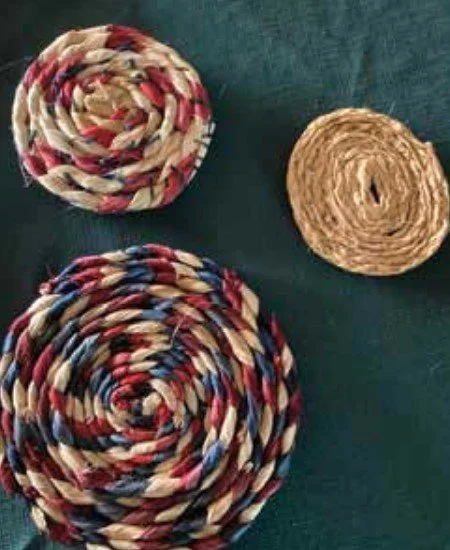
“Hot pads” made using both dyed and not-dyed inner bark of the basswood tree.

Ready to use “natural” material and some that has been dyed with a “store bought” dye. There are, of course, natural dyes that can be used.

This post is an excerpt from the original article. We’re just sharing this great piece with our readers! All credit goes to the original author and website. Please click the link to read the full content on their website. https://www.minnesotaforestry.org/blog/meet-a-tree-basswood

This content is aggregated for informational purposes only. We do not claim ownership and encourage readers to view the full article on the original publisher’s site via the provided link.


READ NEXT

Scientists warn invasive Asian mantises are threatening Europe’s wildlife

​Two striking Asian praying mantis species that have rapidly spread across Europe have now been officially classified as invasive, raising new concerns about their impact on native wildlife. Boosted by climate change and urban environments, these fast-breeding...

Trees keep absorbing carbon long after they stop growing

​Oak trees keep absorbing carbon dioxide long after their annual growth has ended, revealing that photosynthesis and wood production are not as closely linked as scientists once believed. The finding could reshape forecasts of how much carbon forests will be able to...

Trees keep absorbing carbon long after they stop growing

​Oak trees keep absorbing carbon dioxide long after their annual growth has ended, revealing that photosynthesis and wood production are not as closely linked as scientists once believed. The finding could reshape forecasts of how much carbon forests will be able to...

Trees keep absorbing carbon long after they stop growing

​Oak trees keep absorbing carbon dioxide long after their annual growth has ended, revealing that photosynthesis and wood production are not as closely linked as scientists once believed. The finding could reshape forecasts of how much carbon forests will be able to...

From pet to pest, goldfish can wreck entire ecosystems

​A new study reveals that goldfish can do far more than survive in the wild—they can fundamentally reshape freshwater ecosystems. Researchers found they cloud water, damage food webs, and hurt native fish populations, sometimes triggering major ecological shifts. This...

Hidden bird species discovered in Japan after DNA reveals a stunning secret

​A bird long thought to be a single rare species in Japan has turned out to be two. Scientists discovered that the elusive Ijima’s Leaf Warbler and a newly identified Tokara Leaf Warbler look almost identical, but their DNA and songs reveal they are distinct species....

More trees can mean fewer birds, new study reveals

​Trees planted to protect farmland from wind may not be the biodiversity boost many assume. In Japan’s wetland farming landscapes, shelterbelts benefited some birds but sharply reduced grassland and wetland species that need open space. Researchers found grassland...

More trees can mean fewer birds, new study reveals

​Trees planted to protect farmland from wind may not be the biodiversity boost many assume. In Japan’s wetland farming landscapes, shelterbelts benefited some birds but sharply reduced grassland and wetland species that need open space. Researchers found grassland...

T. rex took 40 years to reach full size, scientists find

​Tyrannosaurus rex may have been a much slower grower than scientists realized. A new study of 17 tyrannosaur fossils found that the giant predator likely took about 40 years to reach its full size of roughly eight tons, extending previous estimates by 15 years. This...

Hidden geological process offsets carbon emissions from thawing permafrost

​Scientists found that thawing permafrost can trigger increased rock weathering, a natural process that absorbs CO2 from the atmosphere. In some regions, this carbon uptake was strong enough to fully offset — or even surpass — river greenhouse gas emissions. This post...

Trees keep absorbing carbon long after they stop growing

​Oak trees keep absorbing carbon dioxide long after their annual growth has ended, revealing that photosynthesis and wood production are not as closely linked as scientists once believed. The finding could reshape forecasts of how much carbon forests will be able to...

Trees keep absorbing carbon long after they stop growing

​Oak trees keep absorbing carbon dioxide long after their annual growth has ended, revealing that photosynthesis and wood production are not as closely linked as scientists once believed. The finding could reshape forecasts of how much carbon forests will be able to...

Trees keep absorbing carbon long after they stop growing

​Oak trees keep absorbing carbon dioxide long after their annual growth has ended, revealing that photosynthesis and wood production are not as closely linked as scientists once believed. The finding could reshape forecasts of how much carbon forests will be able to...

Need help in taking care of your trees?