
Meet a Tree: Basswood

by John Zasada

Editor’s note: Author John Zasada is a retired US Forest Service research scientist. His interests and passions (and talents!) turned to special forest products upon his retirement. John is enamored with a common Minnesota tree species: basswood, also known as “American linden.”

 I have been fooling around with basswood inner bark in recent months. The photos accompanying this article are of a couple of “hot pads” made using both dyed and not-dyed inner bark of the basswood tree.

 Minnesota’s basswood trees provide an interesting opportunity to learn about the many uses of trees in the northern part of the state. The use of the inner bark is one way and it is not a well-known use. Many of you are likely familiar with the use of the basswood for carving. Among all of the trees in this region (northern Minnesota), basswood ranks at the top of the list for many carvers.

 Another attribute: basswood flowers provide the “raw material” for bees to make honey and the flowers also make a nice tea. The flowers are fragrant and copious, pollinated by bees and providing for a large honey crop. But basswood is ‘not only for the bees!’ The abundant seeds are an important food source for a wide range of small mammals and birds, even foxes. The bark is eaten by porcupines and squirrels, the latter sometimes stripping the stringy bark for nest construction. Deer browse heavily on young shoots, leaves and winter twigs.

 I have been intrigued with using basswood inner bark for weaving. The use of this material is not particularly well known. I harvest the bark in mid-June to very early July. One of the next ‘first steps’ is separating the bark from the tree and then separating the inner bark from the outer bark. There are several ways of getting it to the useable stage but the one that I use requires separating the inner from the outer bark. This is done by “retting” the bark for 4 to 5 weeks (this is for a lake in Minnesota).

 “Retting” is defined as soaking something in water (usually flax or hemp) to separate the fiber. Retting the basswood bark separates the inner from the outer bark and also separates the layers of inner bark from one another.

 The simplest way to use the basic material is to make a twine from the “natural material” or a combination of this and the dyed material. This is a relatively strong material. If you have a simple rope machine you can use it to make a stronger “twine.”

 The next type of simple but stronger material is a 3-, 4-, or 5-strand handmade braid. This material can be used to make a simple flat square/rectangular flat mat or a round mat.

 To be honest with you, the process from finding a suitable tree to getting useable material takes a good amount of time from beginning to end; more time than many might want to spend on a project. But likely some of you will be interested in the basics. If you want to know more, contact, among others: North House Folk School in Grand Marais and/or Ely Folk School. Of course, there is always the option of just “going online” and searching!
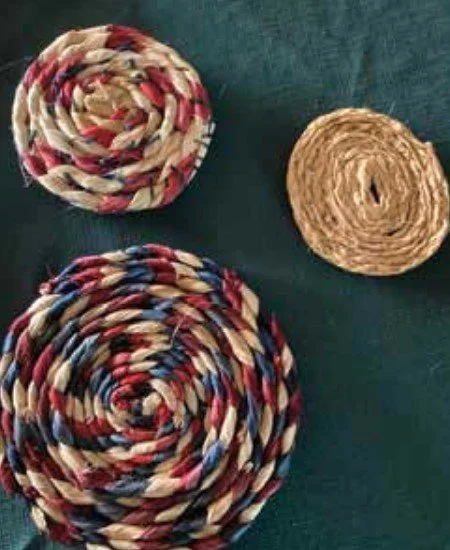
“Hot pads” made using both dyed and not-dyed inner bark of the basswood tree.

Ready to use “natural” material and some that has been dyed with a “store bought” dye. There are, of course, natural dyes that can be used.

This post is an excerpt from the original article. We’re just sharing this great piece with our readers! All credit goes to the original author and website. Please click the link to read the full content on their website. https://www.minnesotaforestry.org/blog/meet-a-tree-basswood

This content is aggregated for informational purposes only. We do not claim ownership and encourage readers to view the full article on the original publisher’s site via the provided link.


READ NEXT

A hidden pollutant is changing how the world’s forests breathe

​A massive global analysis found that nitrogen pollution can either speed up or dramatically slow the natural "breathing" of forest soils, depending on the ecosystem's condition. The results reveal hidden tipping points that could affect how forests store carbon and...

DNA solves 250-year-old mystery of the Seychelles’ lost crocodiles

​Scientists have solved the mystery of the Seychelles’ vanished crocodiles using DNA from historic museum specimens. The reptiles were not a unique species after all, but an isolated population of saltwater crocodiles that likely drifted thousands of kilometers across...

A New York cemetery was hiding 5.5 million bees underground

​A casual walk through an Ithaca cemetery led to the discovery of a gigantic hidden bee population — roughly 5.5 million ground-nesting bees packed beneath the soil. Scientists believe it may be one of the largest bee aggregations ever documented and say the insects...

100-million-year-old bug had crab-like claws unlike any known insect

​Deep inside 100-million-year-old amber from Myanmar, scientists uncovered a bizarre ancient bug with clawed front legs that look more like a crab’s pincers than anything seen in modern insects. The discovery is so unusual that researchers say these crab-like “chelae”...

Scientists discover the perfect temperature to keep mangoes fresh much longer

​Scientists found that storing mangoes at 54°F dramatically slows ripening and keeps the fruit fresh far longer than typical tropical temperatures. The cooler conditions helped mangoes stay firm, retain moisture, and preserve important antioxidants while reducing...

Jupiter’s lightning may be 100x more powerful than Earth’s

​Jupiter’s storms aren’t just gigantic — they may unleash lightning far more powerful than anything on Earth. Using NASA’s Juno spacecraft, scientists discovered that some lightning bolts on the gas giant could pack up to 100 times the punch of Earth’s lightning, and...

Lost for 150,000 years: Rainforest discovery upends human history

​For decades, scientists believed ancient humans avoided dense rainforests, treating them as nearly impossible environments for early survival. But a groundbreaking discovery in West Africa is rewriting that story. Researchers uncovered evidence that humans were...

Lost for 150,000 years: Rainforest discovery upends human history

​For decades, scientists believed ancient humans avoided dense rainforests, treating them as nearly impossible environments for early survival. But a groundbreaking discovery in West Africa is rewriting that story. Researchers uncovered evidence that humans were...

Giant squid discovery uncovers a hidden deep-sea world off Australia

​Scientists exploring deep underwater canyons off the coast of Western Australia uncovered a hidden world packed with bizarre and elusive marine life — including signs of the legendary giant squid. By analyzing traces of DNA floating in seawater from depths exceeding...

Scientists discover the Southern Ocean is “sweating” more as climate change intensifies

​A remote island between Australia and Antarctica is showing signs of a dramatic climate transformation. Scientists found storms over Macquarie Island now unleash much heavier rainfall than they did decades ago, soaking ecosystems and altering fragile vegetation. The...

DNA solves 250-year-old mystery of the Seychelles’ lost crocodiles

​Scientists have solved the mystery of the Seychelles’ vanished crocodiles using DNA from historic museum specimens. The reptiles were not a unique species after all, but an isolated population of saltwater crocodiles that likely drifted thousands of kilometers across...

A New York cemetery was hiding 5.5 million bees underground

​A casual walk through an Ithaca cemetery led to the discovery of a gigantic hidden bee population — roughly 5.5 million ground-nesting bees packed beneath the soil. Scientists believe it may be one of the largest bee aggregations ever documented and say the insects...

100-million-year-old bug had crab-like claws unlike any known insect

​Deep inside 100-million-year-old amber from Myanmar, scientists uncovered a bizarre ancient bug with clawed front legs that look more like a crab’s pincers than anything seen in modern insects. The discovery is so unusual that researchers say these crab-like “chelae”...

Need help in taking care of your trees?