
Meet a Tree: Basswood

by John Zasada

Editor’s note: Author John Zasada is a retired US Forest Service research scientist. His interests and passions (and talents!) turned to special forest products upon his retirement. John is enamored with a common Minnesota tree species: basswood, also known as “American linden.”

 I have been fooling around with basswood inner bark in recent months. The photos accompanying this article are of a couple of “hot pads” made using both dyed and not-dyed inner bark of the basswood tree.

 Minnesota’s basswood trees provide an interesting opportunity to learn about the many uses of trees in the northern part of the state. The use of the inner bark is one way and it is not a well-known use. Many of you are likely familiar with the use of the basswood for carving. Among all of the trees in this region (northern Minnesota), basswood ranks at the top of the list for many carvers.

 Another attribute: basswood flowers provide the “raw material” for bees to make honey and the flowers also make a nice tea. The flowers are fragrant and copious, pollinated by bees and providing for a large honey crop. But basswood is ‘not only for the bees!’ The abundant seeds are an important food source for a wide range of small mammals and birds, even foxes. The bark is eaten by porcupines and squirrels, the latter sometimes stripping the stringy bark for nest construction. Deer browse heavily on young shoots, leaves and winter twigs.

 I have been intrigued with using basswood inner bark for weaving. The use of this material is not particularly well known. I harvest the bark in mid-June to very early July. One of the next ‘first steps’ is separating the bark from the tree and then separating the inner bark from the outer bark. There are several ways of getting it to the useable stage but the one that I use requires separating the inner from the outer bark. This is done by “retting” the bark for 4 to 5 weeks (this is for a lake in Minnesota).

 “Retting” is defined as soaking something in water (usually flax or hemp) to separate the fiber. Retting the basswood bark separates the inner from the outer bark and also separates the layers of inner bark from one another.

 The simplest way to use the basic material is to make a twine from the “natural material” or a combination of this and the dyed material. This is a relatively strong material. If you have a simple rope machine you can use it to make a stronger “twine.”

 The next type of simple but stronger material is a 3-, 4-, or 5-strand handmade braid. This material can be used to make a simple flat square/rectangular flat mat or a round mat.

 To be honest with you, the process from finding a suitable tree to getting useable material takes a good amount of time from beginning to end; more time than many might want to spend on a project. But likely some of you will be interested in the basics. If you want to know more, contact, among others: North House Folk School in Grand Marais and/or Ely Folk School. Of course, there is always the option of just “going online” and searching!
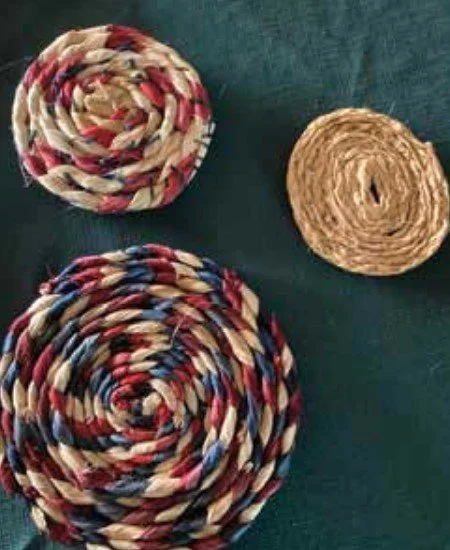
“Hot pads” made using both dyed and not-dyed inner bark of the basswood tree.

Ready to use “natural” material and some that has been dyed with a “store bought” dye. There are, of course, natural dyes that can be used.

This post is an excerpt from the original article. We’re just sharing this great piece with our readers! All credit goes to the original author and website. Please click the link to read the full content on their website. https://www.minnesotaforestry.org/blog/meet-a-tree-basswood

This content is aggregated for informational purposes only. We do not claim ownership and encourage readers to view the full article on the original publisher’s site via the provided link.


READ NEXT

Half of Amazon insects could face dangerous heat stress

​A sweeping new study of more than 2,000 insect species reveals a troubling reality: many insects may be far less capable of coping with rising temperatures than scientists once hoped. Researchers found that while some species living at higher altitudes can...

Climate models may be missing massive carbon emissions from boreal wildfires

​Northern wildfires may be more dangerous for the climate than they appear. Researchers found that fires in boreal forests can burn deep into peat soils, releasing ancient carbon stored for hundreds or thousands of years. These slow, smoldering fires often look small...

Climate models may be missing massive carbon emissions from boreal wildfires

​Northern wildfires may be more dangerous for the climate than they appear. Researchers found that fires in boreal forests can burn deep into peat soils, releasing ancient carbon stored for hundreds or thousands of years. These slow, smoldering fires often look small...

For every known vertebrate species, two more may be hiding in plain sight

​Earth’s vertebrate diversity may be far richer than anyone realized. A sweeping analysis of more than 300 studies suggests that for every known fish, bird, reptile, amphibian, or mammal species, there are about two nearly identical “cryptic” species hiding in plain...

Atacama surprise: The world’s driest desert is teeming with hidden life

​Even in the ultra-dry Atacama Desert, tiny soil-dwelling nematodes are thriving in surprising diversity. Scientists found that biodiversity increases with moisture and altitude shapes which species survive. In the most extreme zones, many nematodes reproduce...

Massive asteroid impact 6.3 million years ago left giant glass field in Brazil

​For the first time ever, scientists have uncovered a vast field of tektites in Brazil — mysterious glassy fragments forged when a powerful extraterrestrial object slammed into Earth about 6.3 million years ago. Named “geraisites” after Minas Gerais, where they were...

Congo basin blackwater lakes are releasing ancient carbon into the atmosphere

​Deep in the Congo Basin, vast peatlands quietly store enormous amounts of Earth’s carbon — but new research suggests this ancient vault may be leaking. Scientists studying Africa’s largest blackwater lakes discovered that significant amounts of carbon dioxide...

Congo basin blackwater lakes are releasing ancient carbon into the atmosphere

​Deep in the Congo Basin, vast peatlands quietly store enormous amounts of Earth’s carbon — but new research suggests this ancient vault may be leaking. Scientists studying Africa’s largest blackwater lakes discovered that significant amounts of carbon dioxide...

Climate change is accelerating but nature is slowing down

​As the planet warms, many expected ecosystems to change faster and faster. Instead, a massive global study shows that species turnover has slowed by about one-third since the 1970s. Nature’s constant reshuffling appears to be driven more by internal ecological...

Europe’s “untouched” wilderness was shaped by Neanderthals and hunter-gatherers

​Long before agriculture, humans were transforming Europe’s wild landscapes. Advanced simulations show that hunting and fire use by Neanderthals and Mesolithic hunter-gatherers reshaped forests and grasslands in measurable ways. By reducing populations of giant...

Need help in taking care of your trees?